



Whether parents sat across the table from me at parents evenings, or adult tutees on the other end of a video call, I often get asked the same question: What else can I be doing to make better progress in learning Spanish?
I know the frustration myself, feeling like a couple of weekly lessons isn’t enough to make serious progress but not knowing where to direct my energy. Do I read up on a new tense? Should I be making flashcards with vocab from my last lesson? How much time should be I spending each day, each week, working towards my goals? The honest answer is there no wrong way to learn a language, so pinging between different topics and tenses and resources is all fine, though perhaps not the most effective strategy!
A lot of adult learners I tutor have learnt a lot of their Spanish independently, often knowing some A2 grammar whilst having gaps in A1 knowledge, or knowing very specific vocabulary about topics more relevant to them, with gaps in more generic vocabulary, and that’s perfectly fine and understandable. Every new thing we learn is progress, and it doesn’t have to be linear – the gaps fill themselves in as you move along, and often I help people to fill in those gaps when they come to me for tutoring.
Make “little and often” your Spanish practice philosophy
The key thing, in my opinion, is to get daily exposure to the language. To reach fluency in Spanish, you will need to assimilate over ten thousand word groups into your vocabulary, be able to decode Spanish you hear using your awareness of Spanish phonics and different accents, and be able to express yourself by applying this vocabulary, grammar and phonetical awareness in your speaking and writing. It sounds like a lot, I know, but that’s why chipping away at this big mountain ahead of you every single day is so important. I know no-one wants to hear this, but spending just an hour or two a week on learning a foreign language will probably never lead to fluency 😬 Two hours a week of lesson time is great, and perhaps another five to ten hours of targeted practice, which I have a resource to help you with!
Remember that all practice is valuable
Some practice activities help us to learn new words, while others consolidate ones we know but may soon start to forget. Some tasks improve our listening skills, whilst others boost our grammatical awareness. Some things we do need not lead to instant progress, if they serve to strengthen or increase our motivation for our learning… Reading a book, in English, about a Spanish speaking country you want to visit may not teach you new Spanish words, but it may motivate you afterwards to spend more time on your Spanish learning. Listening to Spanish music whilst driving home from work may not allow you to study the lyrics as you listen, but it may motivate you to study for half an hour when you get home. The boring tasks may sometimes be the most impactful ones in terms of progress, but you need to balance these with fun or more interesting tasks to avoid getting thoroughly bored and burnt out with what should be an exciting and fulfilling process.
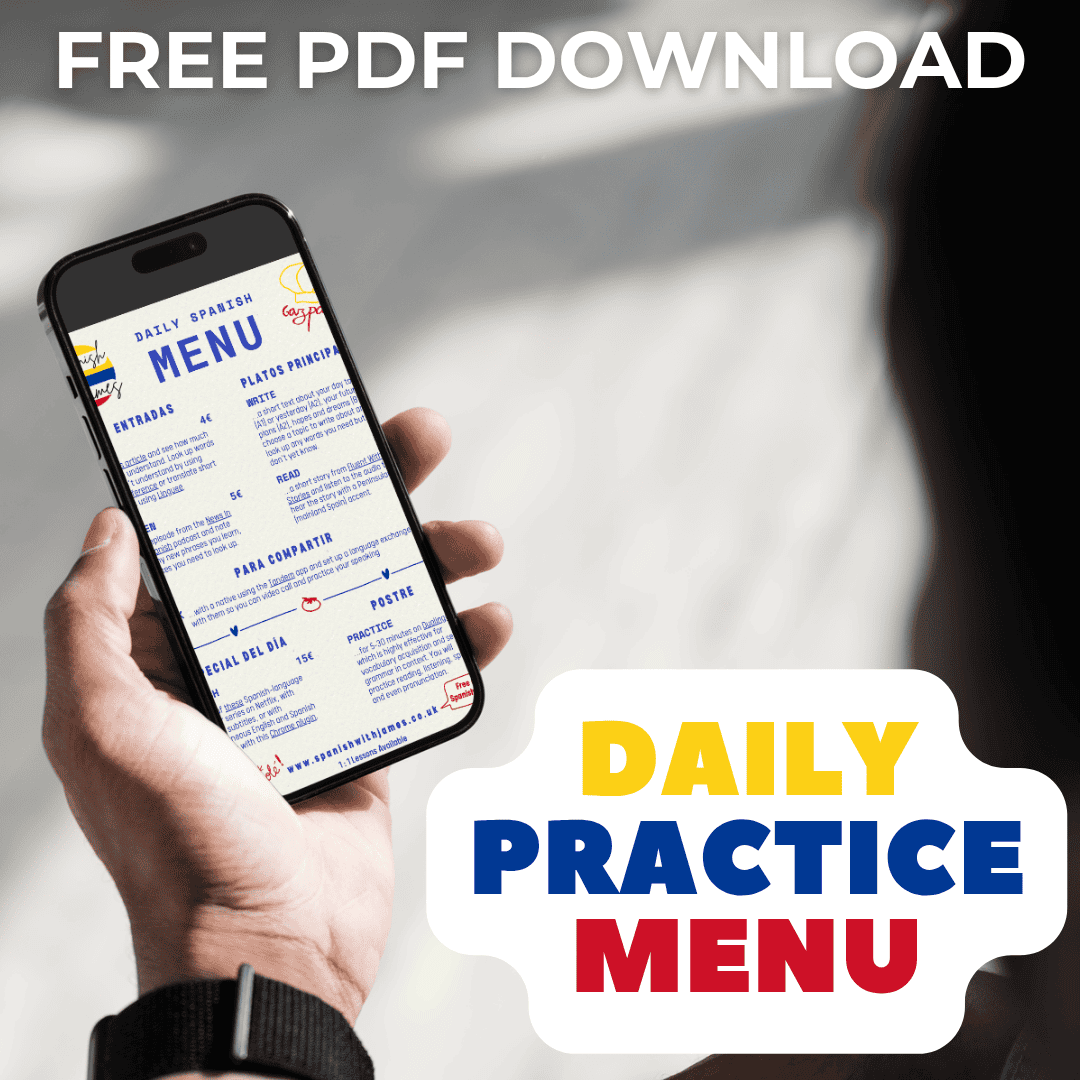
To help you know what to do with those 40 or 50 minutes you can find today to practice your Spanish, I’ve put together a daily practice menu with some ideas to focus on listening, reading, writing and also speaking with native speakers. Below this, you can find another idea bank with even more practice ideas. Remember, little and often is key, so it may be that in the morning you read a short story, then you do some Duolingo over your coffee break, and then in the evening you settle down to watch one of my favourite Spanish-language Netflix series. Whatever you do, do something every day, however small!