
Learn Smarter, Learn Faster: Applying the 80/20 rule to Spanish
One of my biggest tips to language learners is this: focus on high-frequency language.
For example, the word ‘something’ (algo) is worth a thousand words, at least! If I don’t know how to say, “later I’m going to the shop to buy a descaler solution for my kettle”, I can just say: “I’m going to the shop to buy something”, and the conversation keeps flowing.
It reminds me of the time I forgot how to say cheap in German, so I just said not expensive instead. Communicating with flow and fluency isn’t about knowing all the words in a language; it’s about knowing the ones you need to get by and knowing how to work with what you’ve got.
Learning a verb like tener (to have), is going to be so much more useful than a verb like empedernir (to harden), and an adjective like divertido (fun) is going to be more useful on holiday than, let’s say, intravenoso, provided you stay out of the hospital! It seems common sense that we use some words more than others, but the extent to which this is true is actually quite incredible. For example, the English language contains more than 170,000 words in current use, but the average speaker only tends to use a small fraction of these (between 3,000 and 5,000 words) in their day to day life, and native speakers seldom know more that 20,000 word families.
What can I do with one thousand words?
Let’s find out! I will write the next paragraph using only the 1,000 most used words in the English language:
Did you know, I can write quite a lot with just the most used one hundred words? I could probably get by, make myself understood, order coffee and maybe even book a room. I can talk about going to the shop, spending time with my family, walking the dog, sleeping in a nice bed and eating good food. I may not be able to talk about everything, but I can say something about a lot of things, and all with just one hundred words.
My English teacher might not have approved of using ‘nice’ and ‘good’ instead of ‘comfortable’ and ‘delicious’, but those adjectives would take us beyond the top 1,000.
How does this help with Spanish?
In Spanish, the Real Academia’s dictionary contains over 93,000 words, but the 100 most used words are estimated to cover 50% of spoken Spanish, and the top 1000 words cover over 80% of language.
Adding an extra 1000 words in your vocabulary unlocks another 6 or 7% of the language, and a vocabulary of 5000 words gets you to around 90% of coverage. This reminds me of the 80/20 rule, that a small amount of effort yields most of the results. Fluency will never happen if you don’t learn 5000+ words, but it is clear that prioritising the top 100 words, and then the top 1000, will get you there so much faster and allow you to start communicating sooner.
To help you with this, I’ve put together a list of the most used 100 words in Spanish. This resource contains all of the ‘little words’ that make up 50% of Spanish. Most of them are boring, like ‘nice’ and ‘good’, but learning them will have a huge impact on your comprehension. You can also find the 100 most used verbs in Spanish here.
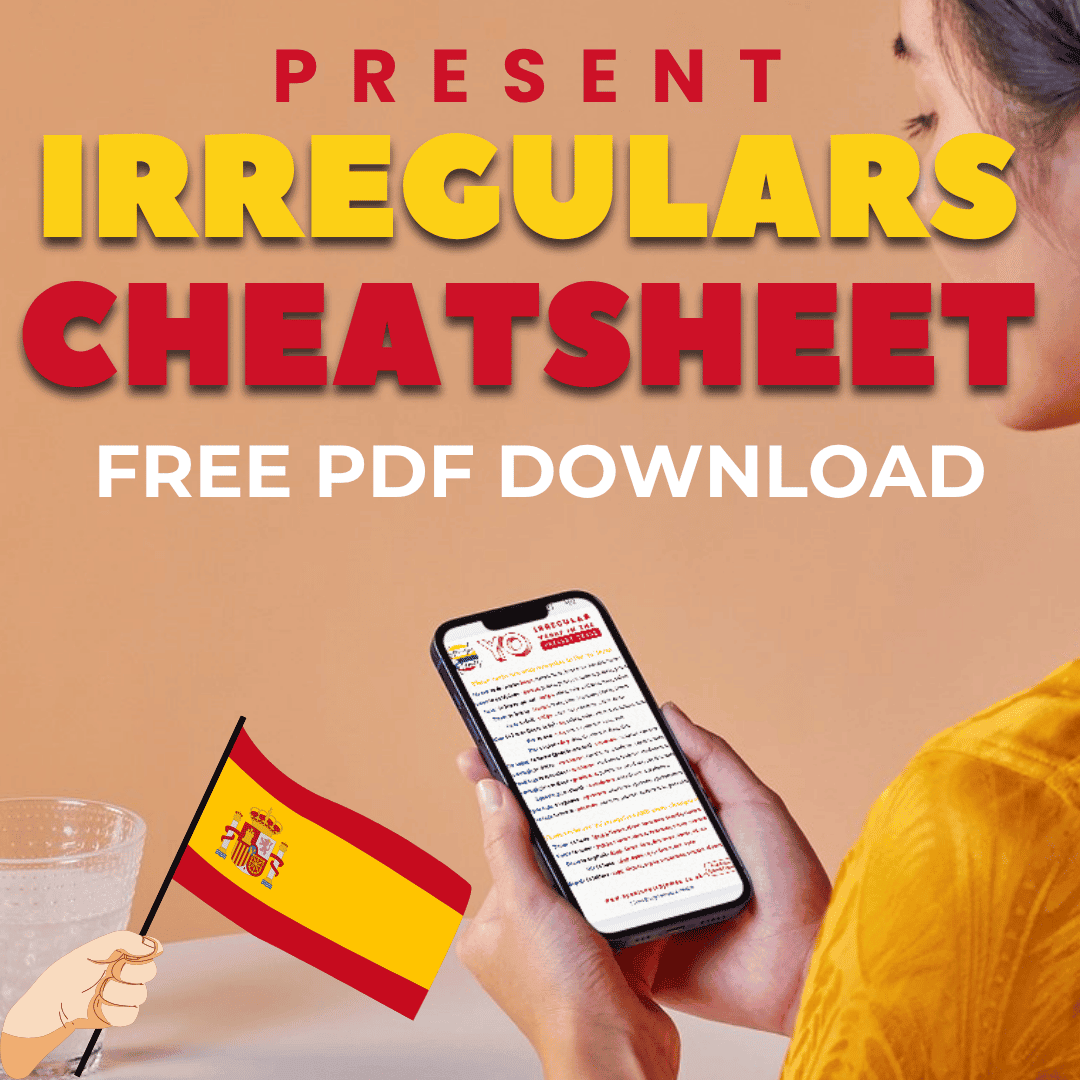
Many of these 100 words are different forms of the same few verbs, so I’ve also put together a useful cheatsheet with these words presented in different category groups, to make studying them and memorising them a little easier. The verbs are presented in their infinitive form.